Who is a Product Manager?
One of my mentors once told me - A Product Manager is a representative of everyone who is not present in the meeting.
Any product has a lot of moving parts and have a lot of associated teams and people doing very different work. There are designers building the right UI and UX, tech team working on the application so that it scales, there are the founders who want a very specific goal from the product and then there’s marketing team who is responsible for getting us more users.
Now, all these teams don’t always communicate with each other (and thank god they don’t). What they do is, they all are in loop with one person - The Product Manager, who has all the context about the product from it’s ideation to it’s goals. So, it becomes a PM’s job to know everything that’s going on in the product and the team.
And not only the team members, a PM is the rightful “advocate of the customer” in the product development organization. Because if they won’t care about the users, there is a possibility that nobody else would.
In a more technical way:
A product manager connects business strategy, design knowledge, and customer needs in order to develop a product that is relevant, feasible, and valuable. PMs are focused on optimizing a product to achieve the business goals and user necessities while maximizing return on investment.
The product manager manages all of the white space around the product. Think of the product manager as connective tissue – they tackle everything that falls outside of the bounds of any of the three core groups.
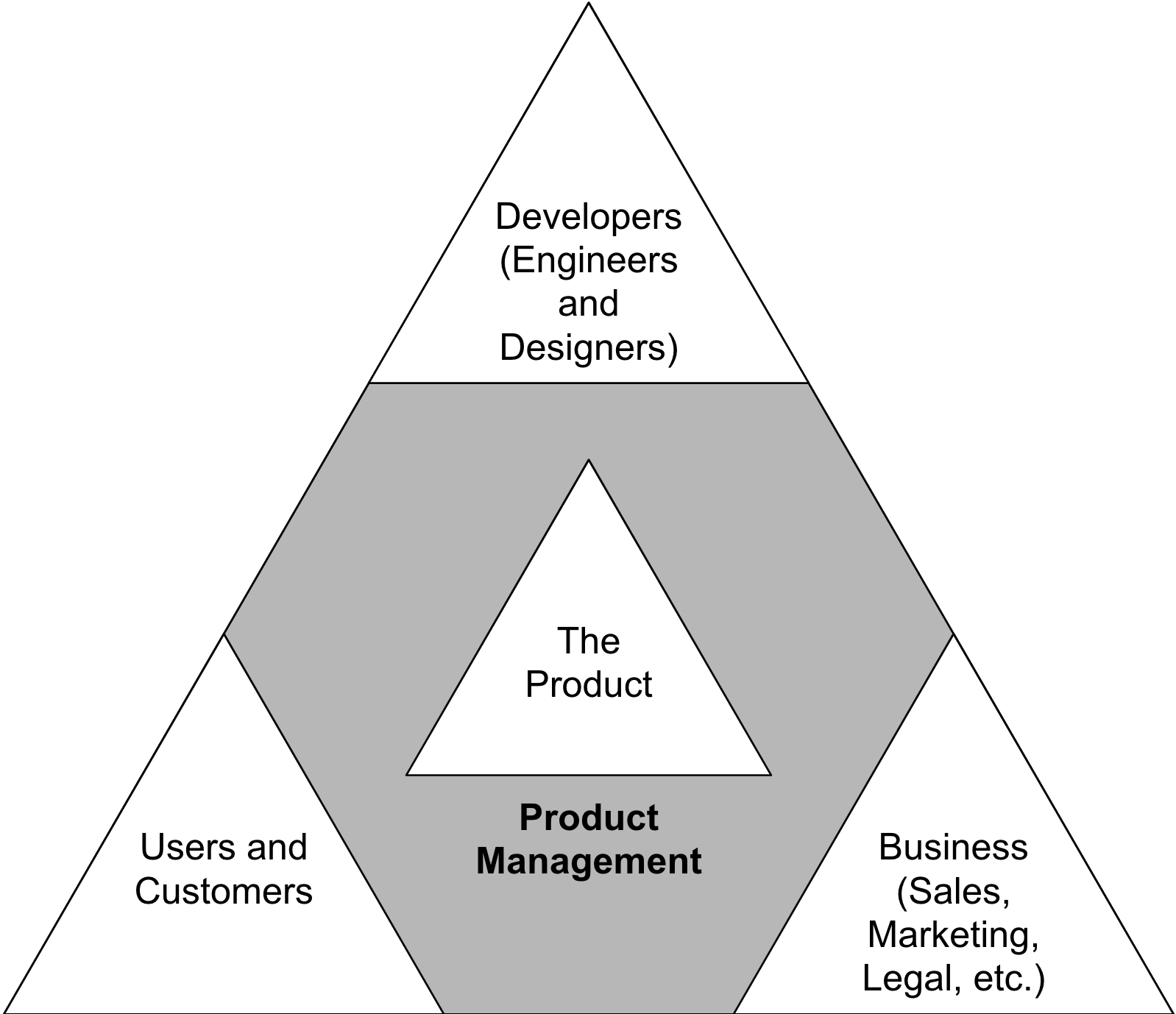
Does this mean all the Product Managers are the same? Nope.
See, every product has a very different sets of Customers, Tech and Business, so the space in which product management is required and to what extend differs a lot.
As an example, an API product manager (PM of teams that build APIs as their product) might have customers who are all engineers. That might mean that the product manager needs to be much better at technical skills.
As a different example, a B2C consumer product manager (PM of teams that build consumer products like Instagram) might be serving millions of customers, and therefore needs to be highly quantitative.
You get it right?
Why do we need a Product Manager?
Okay, before answering that, let’s imagine a world with no product managers.
Now, we have 3 set of people:
- Users who have some pain point that they want to get solved.
- Business who wants to achieve their goals and generate shareholder value.
- Development team who wants to build something that they find meaningful.
Now, the motivation and goals for all three groups are very different and hence, they don’t get along really well.
Users might want services and goods without cost but the business wants to charge them to optimize for profits.
Development team wants to build cool things irrespective of if that’s useful or not while users want very specific things as per their requirement.
And so on..
If there would be so many conflicts, how would we all work? That’s where our Product jumps in.
The product is something that solves the customer’s pain, while enabling the business to be profitable, while being something that the development team is excited to build and can easily maintain. In other words, a great product solves the pains of the customer, the business, and the product development team.
And who handles everything related to the product? The Product Manager.
A PM helps to guide a team in discovering and developing the right product for users
What are the responsibilities of a Product Manager?
A PM’s responsibilities can be summarized in this image in a very simplistic way.
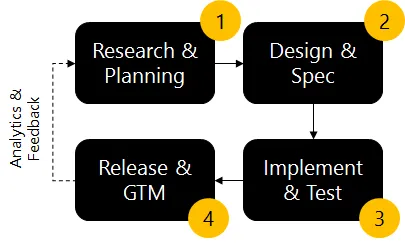
- Once a PM knows the problem to be solved, the workflow starts with research about users, market and competitors alongside careful and meticulous planning how to go about solving the problem.
- Then follows design and writing detailed specifications for the product to be built. Implement & test is a more execution-focused phase where engineering does the heavy lifting and the PM guides how the product shapes up by constantly giving feedback.
- Finally, the PM works to release the product to market. Go-to-market activities dominate a PM’s mind in this phase.
- The cycle of one workflow completes with the PM consuming analytics and feedback data coming from actual users and taking cues to improve the product in the next cycle.
The exact mix changes by company and product stage. An early-stage PM may spend more time on discovery and go-to-market; a platform PM may spend more time on APIs, reliability, and internal stakeholders. The constant is accountability for making better product decisions—not authority over every function.
Put this lesson into practice
Choose a product you use weekly. Write down its primary user, the problem it solves, the behavior that indicates value, and one business outcome that behavior supports. Then list one decision a PM might make in discovery, delivery, and launch. This exercise turns a vague job title into a concrete decision-making role.
Next, read common product manager myths so you can distinguish the real job from popular misconceptions.