User Interviews
User interviews are sometimes referred to as “empathy studies” because they provide an opportunity for product teams to develop a deep understanding of their users’ needs, goals, and pain points.
By asking open-ended questions and listening to user’s responses, you can gain insight into the experiences, behaviors, and motivations that drive user behavior.
There are three types of User Interviews:
- Structured interviews
- In a structured interview, you follow a specific set of questions. Sometimes, you prepare a script too.
- Structured interviews can help you to identify trends and patterns from the user responses as all the participants are asked the same question. The data collected here is more quantitative.
- Although, such interviews don’t allow you much flexibility in exploring unexpected insights by talking about new topics or following up on something the user says.
- Semi-structured interviews
- These are more flexible. You prepare a loose set of questions, but they can be adjusted and the flow of the conversation can be in any direction.
- This approach allows you to follow up on the participant's responses and ask clarifying questions to explore unexpected insights.
- Exploratory interviews
- These are pretty open-ended interviews where you don’t follow a specific script or any set of questions, and instead allow the conversation to develop naturally.
- This type of interview is useful when you want to uncover new insights, test assumptions, or explore a new problem space.
- Exploratory interviews may not be as reliable as other types of interviews since there is no set structure or standard set of questions, but they can lead to valuable insights that can inform future research.
Things to remember while conducting a user interview
Although there is no “perfect” or sure shot way of conducting the best interview, but there are a few things that you should keep in mind every time you talk to your users or potential users.
- Define the purpose and scope of the interview beforehand so that you know what your goal is and plan the questions and conversation accordingly.
- Find participants: Identify users who match the profile of the people you want to interview. If you are working on a new idea, I would suggest don’t go to your friends or family, instead find people who are strangers or who would at least be honest with you.
- Before the interview, provide participants with some background information on the purpose and scope of the interview before the meeting. Don’t give too much information that it creates bias.
- While conducting the interview, take care of the following things.
-
Begin by introducing yourself and explaining the purpose of the interview.
Try to keep it normal and don’t let them feel like they are talking to an authority.
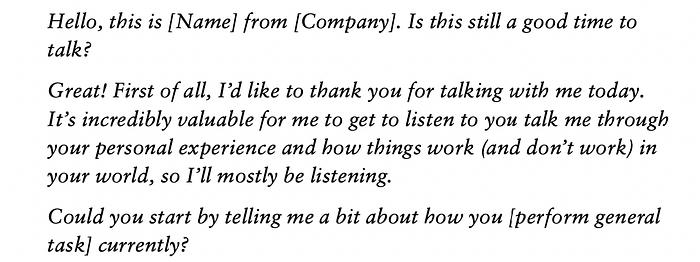
You can use this template to do the introductions.
-
Make it very clear that the interview is not a test, and that there are no right or wrong answers in this conversation.
-
Listen actively and ask open-ended questions to encourage participants to share their thoughts and feelings.
-
Don’t ask leading questions and don’t pressure the user to say yes to your biases.
-
Use follow-up questions to clarify and dig deeper into their responses.
-
- Analyze the results: After the interview, review your notes and identify common themes and patterns. Look for insights and trends that can help you identify user needs and pain points.
- Synthesize your findings: Use the insights you gained from the interviews to develop personas, user stories, and other user-centric artifacts that can guide your product development process.
- Follow up: After the interview, thank the participants for their time and input. Let them know how their feedback will be used and keep them updated on the progress of the project.
Here’s a list of questions that you can use while conducting the interview.
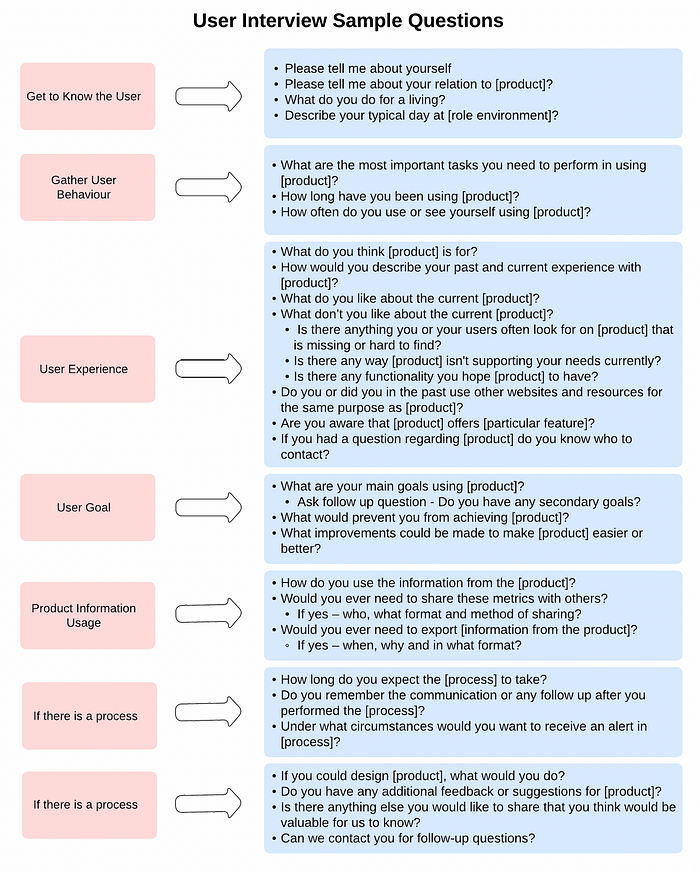
Better questions and useful follow-ups
Ask about specific past behavior: “Tell me about the last time this happened.” Follow with “What did you do next?”, “What made that difficult?”, and “How did you decide?” These prompts produce stronger evidence than hypothetical questions such as “Would you use this feature?”
After each interview, separate observations, direct quotes, interpretations, and open questions. Debrief quickly while the context is fresh, but wait for patterns across participants before declaring an insight. Your goal is not to collect feature requests; it is to understand goals, constraints, workarounds, and the meaning behind behavior.
Use the next lesson on user segmentation to decide whose patterns should be analyzed together.